News
Health insurance premiums 2027: the most expensive and the most affordable cantons
Average health insurance premiums for 2027 vary greatly from one canton to another. Find out where you will pay the most, where premiums are lowest and what it means for your profile.
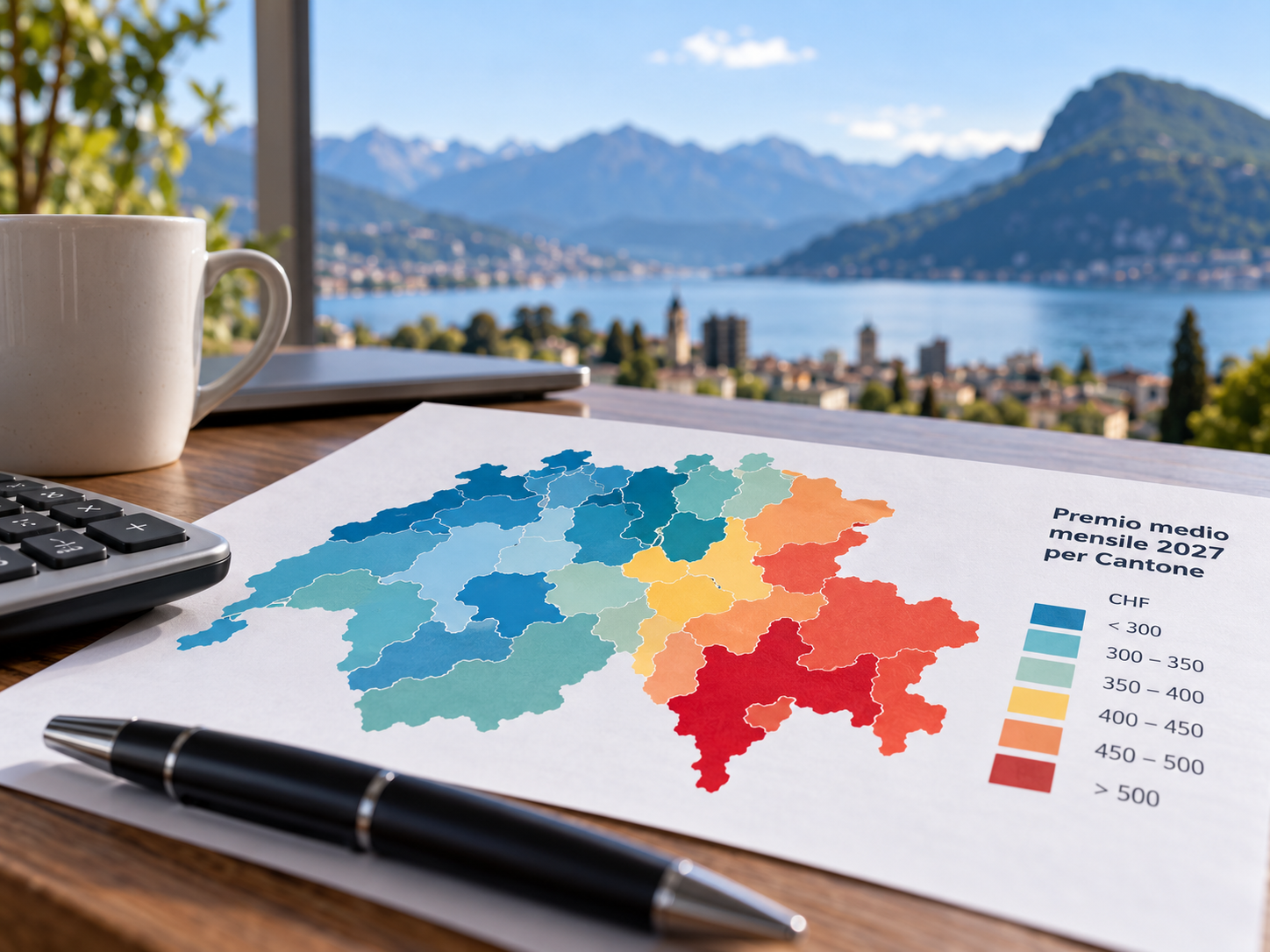
On 29 September the new health insurance premiums for 2027 finally arrived. After weeks of previews and forecasts, there are now the official figures published by the Federal Office of Public Health (FOPH).
The first piece of news is that, on average, premiums in Switzerland will rise by 5%, to CHF 412 per month. For adults the average will be CHF 487.60, for young adults CHF 338.80 and for minors CHF 128.10.
But talking only about the national average is not enough. The differences between one canton and another are in fact very important. And for those living in Ticino, some figures deserve particular attention.
Health insurance premiums 2027: the situation canton by canton
The table shows the average monthly premium for 2027 for each canton, considering all age groups, optional deductibles and the different insurance models.
| Canton | Average monthly premium 2027 |
|---|---|
| Aargau | CHF 390,50 |
| Appenzell Inner Rhodes | CHF 285,50 |
| Appenzell Outer Rhodes | CHF 354,30 |
| Bern | CHF 420,20 |
| Basel-Landschaft | CHF 462,20 |
| Basel-Stadt | CHF 491,30 |
| Fribourg | CHF 385,60 |
| Geneva | CHF 508,60 |
| Glarus | CHF 365,00 |
| Graubünden | CHF 360,30 |
| Jura | CHF 462,30 |
| Lucerne | CHF 354,30 |
| Neuchâtel | CHF 468,90 |
| Nidwalden | CHF 339,90 |
| Obwalden | CHF 327,40 |
| St. Gallen | CHF 358,40 |
| Schaffhausen | CHF 401,20 |
| Solothurn | CHF 417,50 |
| Schwyz | CHF 355,00 |
| Thurgau | CHF 364,60 |
| Ticino | CHF 519,90 |
| Uri | CHF 317,40 |
| Vaud | CHF 454,50 |
| Valais | CHF 390,20 |
| Zug | CHF 276,20 |
| Zurich | CHF 404,40 |
| Switzerland | CHF 412,00 |
Source: FOPH, average cantonal premiums 2026/2027.
Zug, Appenzell and Uri among the lowest average premiums
Looking at the 2027 data, the differences are immediately evident. The lowest average premium is that of Zug, at CHF 276.20 per month. Appenzell Inner Rhodes follows with CHF 285.50 and Uri with CHF 317.40.
At the bottom of the table we also find Obwalden, Nidwalden and several cantons of eastern Switzerland. This does not mean, of course, that every person living in these cantons will pay those amounts.
The real premium depends on the personal situation: age, municipality of residence, deductible, insurance model, insurer and accident coverage can significantly change the final amount.
Ticino: average premium of CHF 519.90
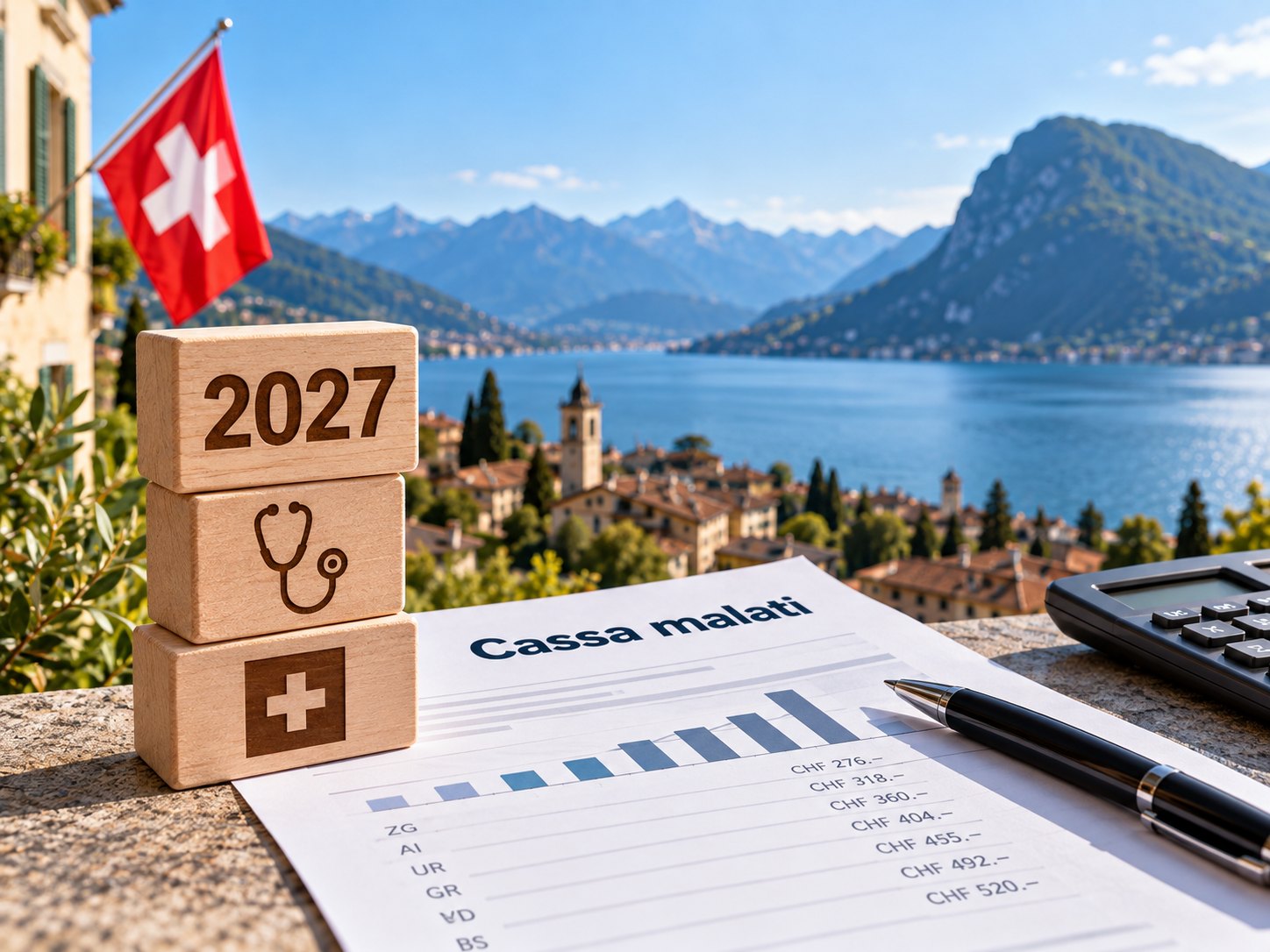
The figure that stands out most for those living in Ticino is the average premium of CHF 519.90 per month. It is the highest value in the FOPH cantonal table. Geneva follows with CHF 508.60, Basel-Stadt with 491.30, Neuchâtel with 468.90 and Jura with 462.30.
But there is another interesting figure. Although the average premium level in Ticino is high, the increase expected for 2027 is 3.7%, therefore lower than the Swiss average of 5%.
In practice, Ticino starts from an already high premium level, but the percentage growth for 2027 is more contained than that recorded in several other cantons.
How much does the percentage increase really matter?
When reading the 2027 premium data it is easy to focus only on the percentage increase. But it is not always the best way to understand how spending will really change.
A 4% increase on an average premium of CHF 300 has a very different effect from the same 4% applied to a premium of CHF 500. For this reason it is useful to look at two numbers together: the average premium and its change compared with 2026.
In 2027, for example, the national average grows by 5%, equal to about CHF 19.70 more per month. Over a year that means almost CHF 240 more per insured person, considering the national average premium.
There is, however, no single “canton premium”
Some cantons are divided into several premium regions. This also happens in Ticino, where there are two regions. This means that two people living in the same canton can have different premiums even if they are the same age and choose the same deductible.
The municipality of residence and its premium region can make the difference. For this reason, the average cantonal premium is useful for understanding the general situation, but does not tell you how much an individual will pay in 2027.
The new premiums change how you look at your health insurance
Now that the 2027 premiums are official, the most interesting figure is not just knowing which canton has the highest or lowest average. The more useful question is another: how much will I pay in 2027?
The answer depends on the combination of several factors: residence, age, deductible, insurance model, insurer and accident coverage.
And this is precisely why comparing only your current premium with the new one may not be enough. Sometimes the difference is found not simply by changing insurer, but also by considering a different deductible or another insurance model.
With the 2027 premiums now published, this is the moment when many insured people can get a clearer picture of the available alternatives and assess whether their configuration is still suited to their personal situation.
More blog articles

Guides
Health insurance in Ticino 2027: premiums, regions and what to know
For people living in Ticino, the new health insurance premiums are one of the main novelties for 2027. The publication of the premiums shows how the cost of basic insurance will change next year and makes it possible to compare the available options.
Guides
Health insurance comparison 2027: how to compare premiums in Switzerland
With the publication of the new 2027 premiums, many insured people face the same question: how can I tell whether my premium is still competitive?

News
Health insurance premiums 2027 in Ticino: how much they rise and what changes
For insured people in Ticino there is an important difference compared to the national figure: in 2027 health insurance premiums will rise, but the average increase in Ticino will be lower than the Swiss one.